

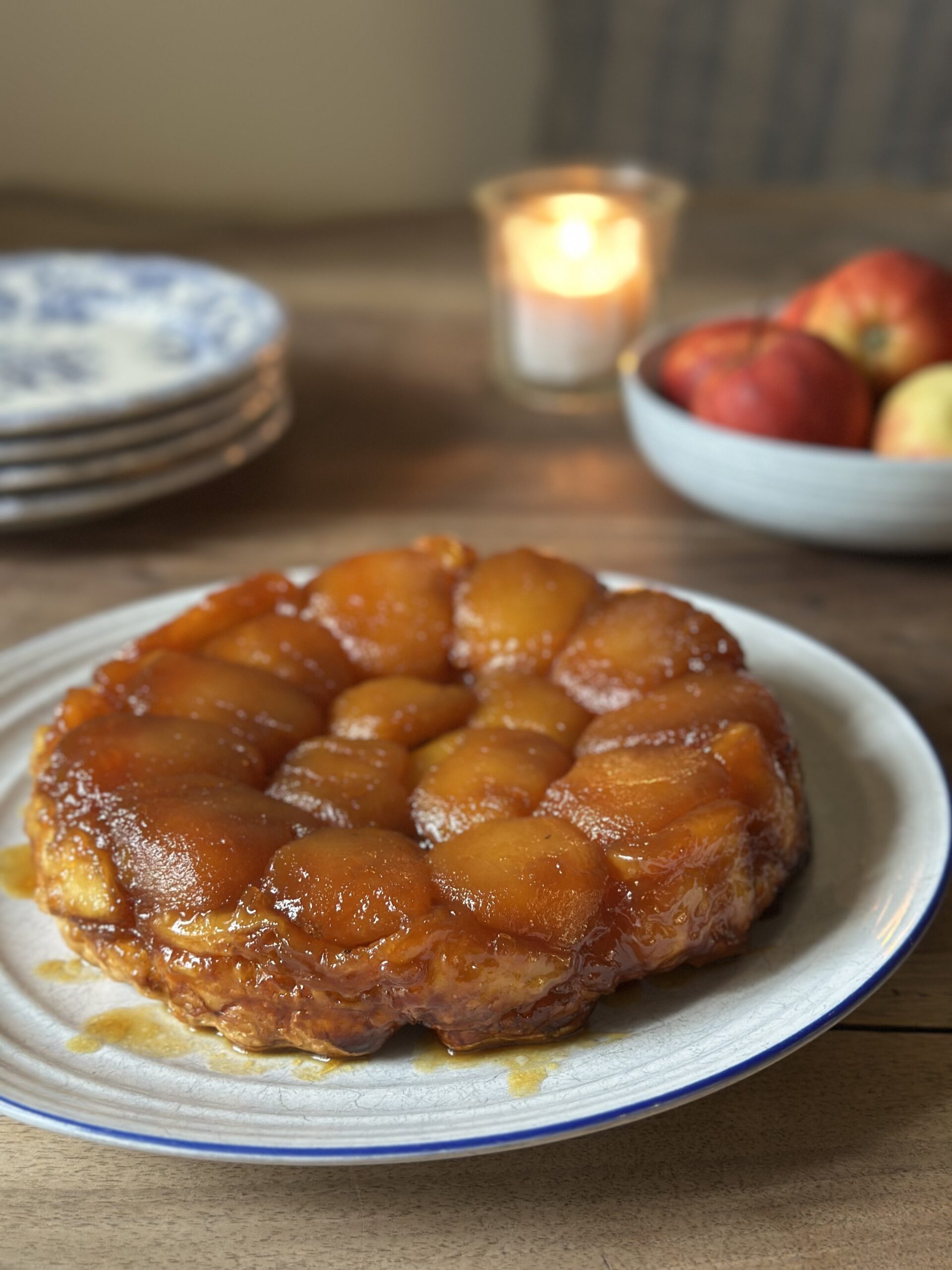
Our old, gnarly apple tree had a bumper crop this summer, its crooked branches laden with Reinette de Canada apples, their brown blushed skins looking ugly and unpromising, but their flesh sweet and floral and perfect for cooking. Often I spend a day peeling and slicing each apple into bags for the freezer ready for pies and crumbles, but this year I didn’t have time. Instead, I spread them out in single layers on old fruit crates in the bottom of the kitchen larder cupboard and in my garden workshop in the hopes they’d stay fresh through the colder months. The ones in the larder cupboard are starting to soften a little, which gave me the perfect excuse for making a tarte tatin.
Tarte tatins can be a little intimidating; hot caramel, puff pastry, inverting the pan at the end. But actually they aren’t that difficult if you know a few little tricks, and the buttery pastry, caramelised apples and a hint of calva make this such a lovely pudding for a cold winter’s day. It’s definitely worth the effort and is a real showstopper that can be largely made in advance and just baked off when you need it. It’s good warm or at room temperature too.
I make mine in a 20cm/8in cake tin rather than an oven proof frying pan, it makes it much easier to turn out without a hot handle getting in the way and I often use shop bought puff pastry too to make things really simple.
Serves 6
4-5 apples such as Gala, Braeburn or Reinette de Canada (it needs to be an apple that keeps its shape when cooked)
Juice 1/2 lemon
175g caster sugar
50g butter
50ml calvados (optional)
1 x pack ready rolled puff pastry
20cm/8in cake tin
Peel your apples and slice into quarters, carefully removing the core from each piece. Toss in the lemon just to stop them browning and arrange them in the cake tin, fitting them together snugly to see if they fit. The apples will shrink slightly as they cook, so try not to have any gaps and pop an extra quarter in the middle to fill any spaces that might appear during cooking. Tip the apple pieces back into a bowl and set aside.
Put the sugar into a medium pan – ideally not non-stick and made from a light coloured metal so you can see the caramel change colour. Heat over a medium high heat, undisturbed, watching all the time for the sugar to start to melt and caramelise around the edges. You can swirl the pan gently to encourage the sugar crystals to dissolve, stirring briefly with a wooden spoon to draw the melted sugar into the middle of the pan and to encourage any undissolved lumps of sugar to melt into the caramel.
Keep swirling the pan until the caramel reaches a dark amber colour. Turn off the heat, then whisk in the butter and calvados (if using). It will bubble ferociously so be careful, keep stirring until the butter has combined with the sugar and you have a smooth, buttery caramel. Pour into the cake tin and arrange your apple slices on top of the caramel.
Unroll your pastry and if it isn’t already round, cut out a rough circle that is two inches larger than your cake tin. Drape the pastry over the pan and tuck the excess edges under and down and around the apples, using a the handle of a knife to ease the pastry down the sides of the pan if needed.
At this point you can either cover the tarte tatin in cling film and refrigerate until you need to bake it or pre-heat the oven to 180c/350f and bake for 40-45 mins until the pastry is golden and brown and the caramel is bubbling.
Allow the tarte tatin to cool for 10-15 mins before turning it out, this gives the caramel time to soak into the apples and release from the bottom of the tin so it stays together when you turn it out – and it means everything is cooler and safer too. Slide a knife around the edge of the tarte to loosen any sticky caramel, then put your serving plate on top of the pan. Using a tea towel to protect your hands so you can grip both the plate and the tin, invert the tarte onto the plate. You should hear it release and then you can lift the tin off to reveal your tarte tatin.
Serve warm or at room temperature with cream or vanilla ice cream.


